Direct integration equations
#008
Problem
Classification
- exponential antiderivative
- solution family
Method
- direct integration
Solution
Simulation & Code
Computational workSimulation
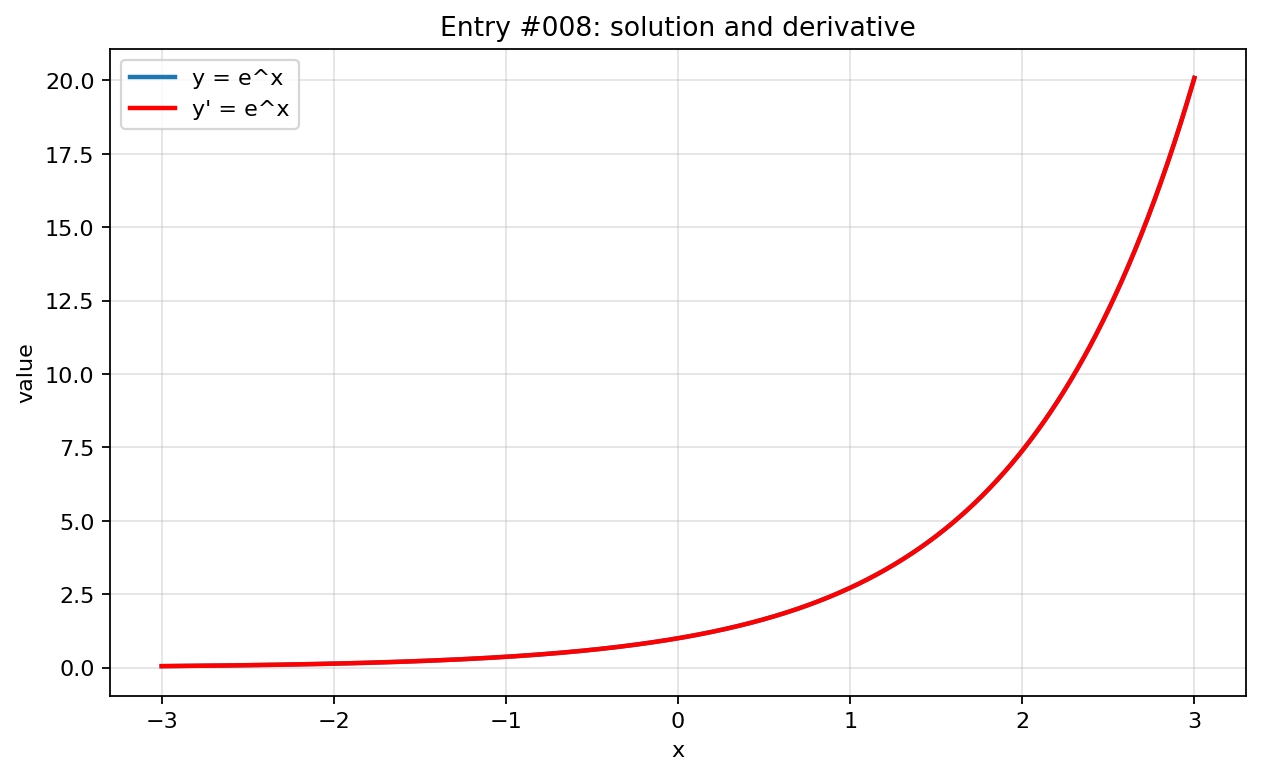
Python codeOpen
import numpy as np
import matplotlib.pyplot as plt

x = np.linspace(-3, 3, 800)

with np.errstate(divide="ignore", invalid="ignore", over="ignore"):
    y = np.exp(x)
    y_prime = np.exp(x)

plt.figure(figsize=(8, 5))
plt.plot(x, y, label="y = e^x", linewidth=2)
plt.plot(x, y_prime, label="y' = e^x", linewidth=2, color="red")
plt.title("Entry #008: solution and derivative")
plt.xlabel("x")
plt.ylabel("value")
plt.grid(True, alpha=0.35)
plt.legend()
plt.tight_layout()
plt.show()
Handwritten derivation
Download full PDFTakeaway & Interpretation
This equation says the solution's slope is controlled entirely by e^x. After integrating, the solution family becomes y = e^x + C, meaning every solution has the same overall shape but may be shifted vertically by the constant C. This function is equal to its own derivative, so the nonconstant part of the solution has the same form as the original slope function.