Direct integration equations
#014
Problem
Classification
- trigonometric antiderivative
- domain restriction
- singularity
- solution family
Method
- direct integration
Solution
Simulation & Code
Computational workSimulation
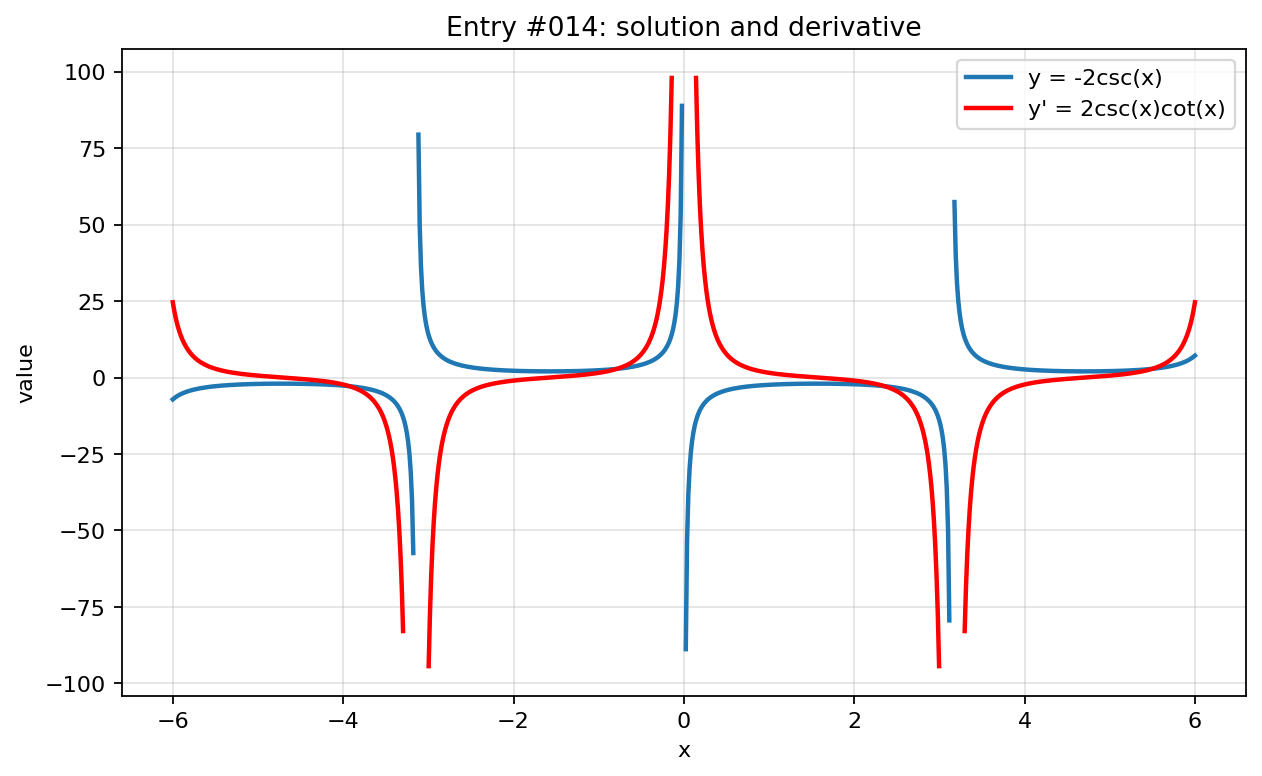
Python codeOpen
import numpy as np
import matplotlib.pyplot as plt

x = np.linspace(-6, 6, 800)

with np.errstate(divide="ignore", invalid="ignore", over="ignore"):
    y = -2/np.sin(x)
    y_prime = (2*np.cos(x))/(np.sin(x)**2)


def mask(values, limit=100):
    return np.where(np.isfinite(values) & (np.abs(values) <= limit), values, np.nan)

y = mask(y)
y_prime = mask(y_prime)
plt.figure(figsize=(8, 5))
plt.plot(x, y, label="y = -2csc(x)", linewidth=2)
plt.plot(x, y_prime, label="y' = 2csc(x)cot(x)", linewidth=2, color="red")
plt.title("Entry #014: solution and derivative")
plt.xlabel("x")
plt.ylabel("value")
plt.grid(True, alpha=0.35)
plt.legend()
plt.tight_layout()
plt.show()
Handwritten derivation
Download full PDFTakeaway & Interpretation
This equation says the solution's slope is controlled entirely by 2csc(x)cot(x). After integrating, the solution family becomes y = -2csc(x) + C, meaning every solution has the same overall shape but may be shifted vertically by the constant C. This function has more interesting periodic singularities, similar to #013, coming from the undefined values of the cosecant and cotangent factors.